


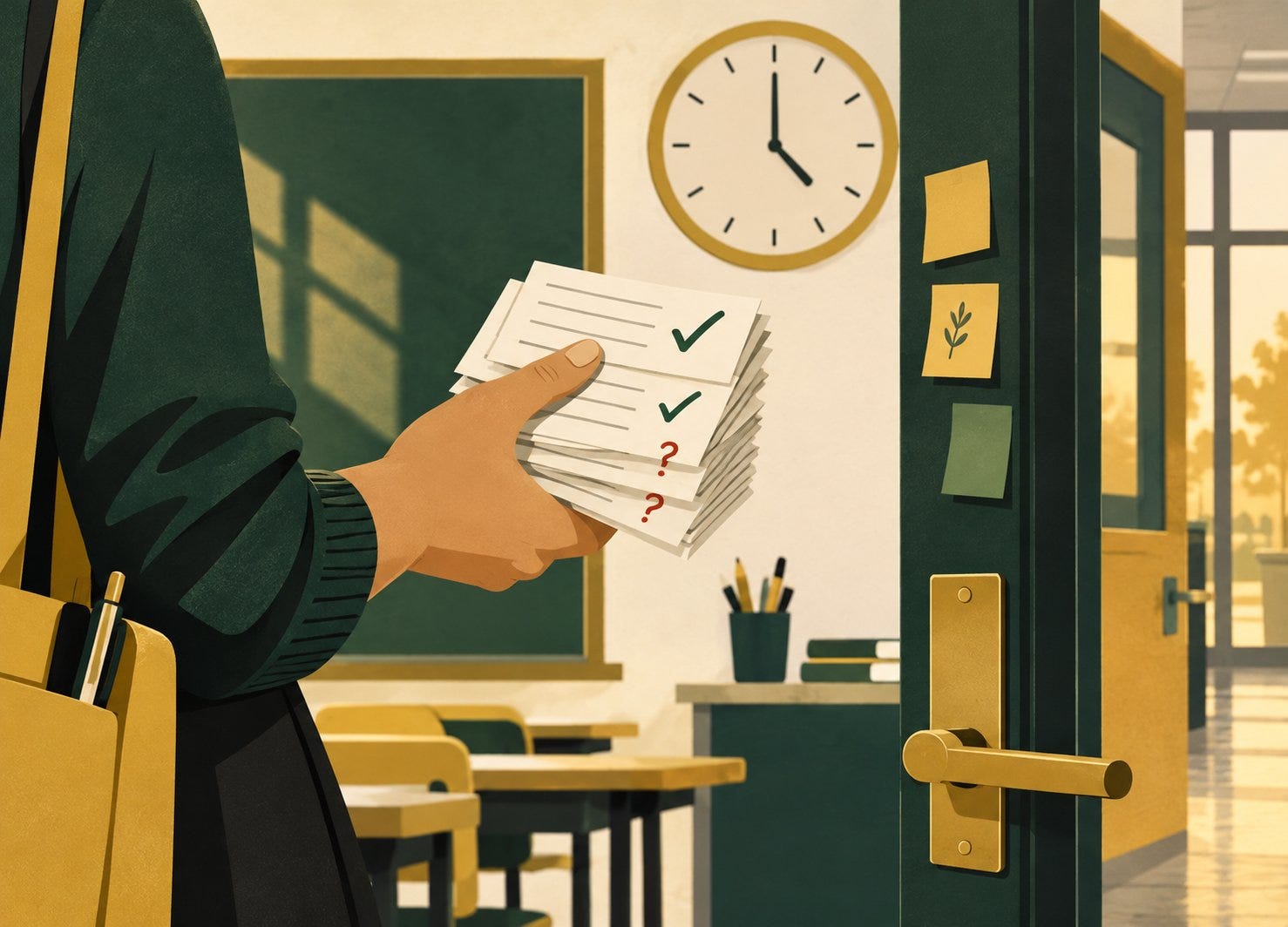
You taught the lesson. Students nodded. A few answered questions. Then the bell rang and everyone left.
Did they get it? Most days, the honest answer is that you don't know. You know what the three students who raised their hands understood. You don't know about the other twenty-five.
An exit ticket fixes that. It is one short question that every student answers before they leave, in two to five minutes. It tells you who got it, who is close, and who needs help tomorrow. Read the basics here: What Is an Exit Ticket?
And if you've ever wondered about the name: Exit Ticket vs. Exit Slip: Is There a Difference?
The three rules of a useful exit ticket
1. Ask one thing. One question, tied to today's objective. If you need three questions to find out whether they learned it, the objective was too big.
2. Keep it short. Students should finish in two to three minutes. You should be able to sort the whole stack in five.
3. Use the answers tomorrow. This is the part most teachers skip. An exit ticket you never look at is just a worksheet with a nicer name. More on this below.
For a step-by-step setup that won't cost you instruction time, see How to Use Exit Tickets Without Losing Class Time.
25 exit ticket prompts that work in any subject
Check understanding
In one sentence, what was today's lesson about?
What is the most important thing you learned today, and why does it matter?
Explain today's main idea to a student who was absent.
Write one question that could be on a quiz about today's lesson. Then answer it.
What is one example of today's concept that we did not talk about in class?
Find the confusion
What is one thing you are still confused about?
Rate your understanding from 1 to 5. What would move you up one number?
Which part of today's lesson would you want explained again?
What mistake do you think students make most often with this?
Finish the sentence: "I get it, except for..."
Make connections
How does today connect to yesterday's lesson?
Where could you see this outside of school?
What does this remind you of from another class?
Predict what we'll learn tomorrow, based on today.
If you had to teach this with a drawing, what would you draw?
Reflect and apply
What helped you learn today? What got in your way?
Solve one problem like the ones we did today.
Agree or disagree with a statement from today's lesson, and give one reason.
Write a headline that sums up today's lesson.
What would you tell a friend who missed class today?
Quick formats
3-2-1: Three things you learned, two things you found interesting, one question you still have. (More on the 3-2-1 exit ticket)
Traffic light: Green (got it), yellow (mostly), red (lost).
Fist to Five: Hold up zero to five fingers to show your confidence.
One word: Sum up today in one word, then explain it in one sentence.
Muddiest point: What was the least clear part of today?
Want more? Exit Ticket Ideas That Work in Any Subject has a longer list, and the Daily Exit Tickets page puts a new one up every day.
What to do with the answers the next day
This is where exit tickets earn their keep. After class, sort the stack into three piles:
Got it: They're ready to move on.
Almost: A small misunderstanding. A two-minute fix at the start of class.
Not yet: These students need a reteach, a small group, or a check-in during work time.
Now tomorrow's plan writes itself. Start class by addressing the most common mistake in the "almost" pile, maybe as tomorrow's bell ringer. Pull the "not yet" group together while everyone else works.
For more on this, see What to Do With Exit Ticket Answers the Next Day.
Should you grade them?
Mostly no. Exit tickets are for information, not for the gradebook. If students think a wrong answer will hurt their grade, they'll copy from a neighbor and you'll lose the very information you were trying to collect. A completion check works well. The full breakdown is here: Should You Grade Exit Tickets?
Paper, digital, or games?
All three work. Pick the one that fits your room.
Paper: Fast, no tech, nothing to log into. Print slips at 2, 4, or 6 per page with the free printable exit tickets, or build your own with the exit ticket template guide.
Digital: Easier to sort and save, but slower if devices are slow. See Digital Exit Tickets vs. Paper.
Games: Good for Fridays and for the last five minutes when energy is low. See Exit Ticket Games That Make the Last Five Minutes Fun.
Exit tickets by subject and grade
The free tool that runs it for you
The Daily Exit Tickets page has everything in one place:
A new exit ticket every day
A full ticket library
Board mode with huge text and a 1, 2, 3, or 5 minute timer
Games: spinner, dice, and mystery cards
Quick checks: Fist to Five, Traffic Light, and Thumbs Check, with a tap-to-count tally
A name picker
Printable slips
No sign-up, no student accounts, no student data.
Pair it with a daily bell ringer at the start of class and you've covered both ends of the period.