


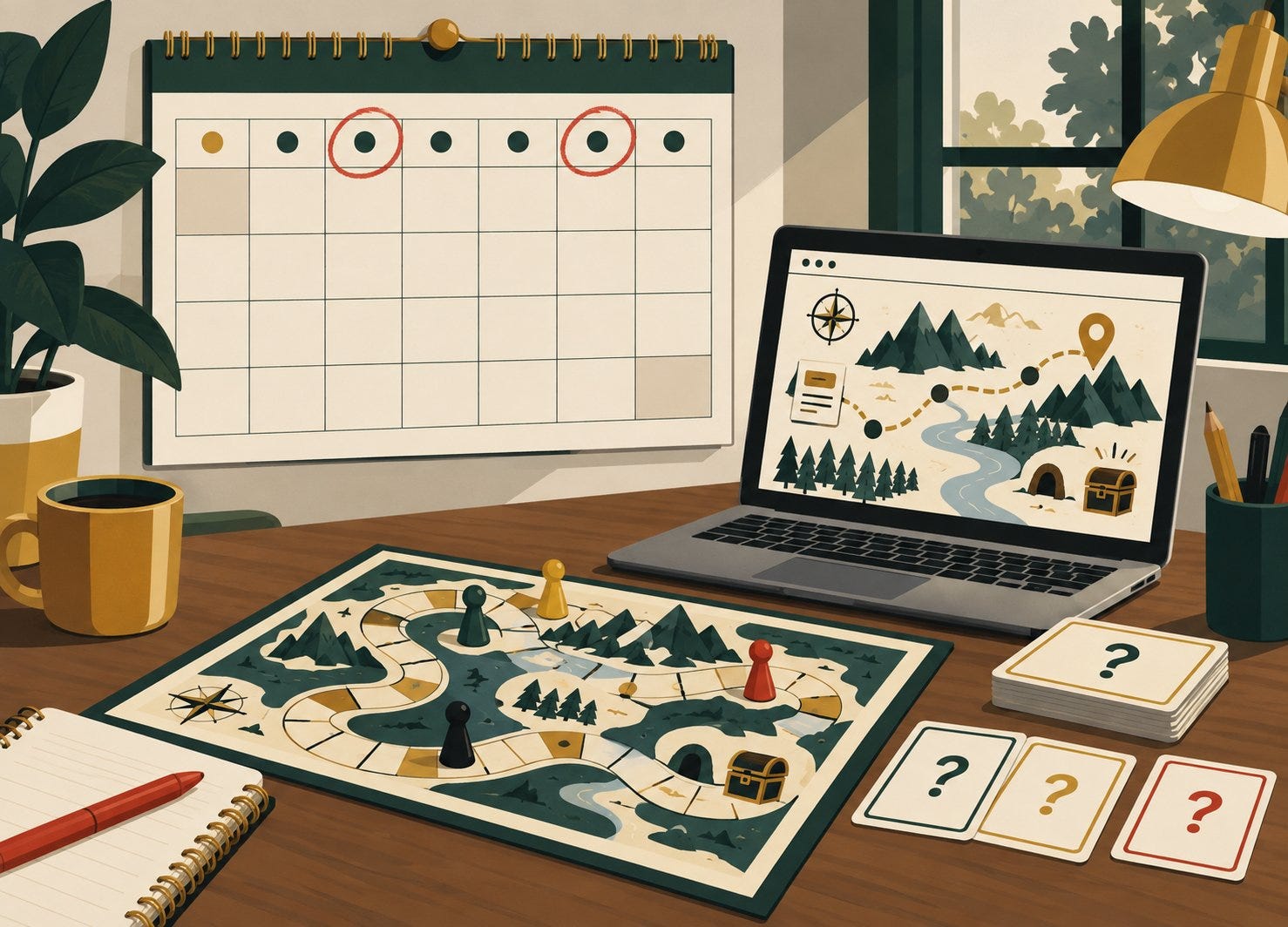
Three-day weekends are great. Nobody argues with that part.
The problem is the two days on either side of one: the Friday before and the Tuesday after. Most of us write those days off every year. Students are wound up on Friday and worn out on Tuesday, and the lesson you planned gets half the attention it deserves.
There's a better way to use them. The full write-up lives on Elevate the Norm, Teaching After a Long Weekend: A 3-Day Weekend Classroom Plan, and here's the short version.
Friday: don't review
Review is the reflex, because it feels responsible. But a review on a Friday afternoon, aimed at a room that has mentally left the building, won't fix anything. If students didn't have it on Wednesday, one more pass at 2:15 on Friday isn't the answer.
Save review for a day when students can actually put the time in.
Play a game you built
Use those days for a game. Not something pulled off a shelf, but a game you designed to create curiosity about the next topic.
The engine is curiosity: ask questions students probably don't know the answer to yet. Not knowing is the point. It's what gets a teenager to pick up a laptop on a Friday afternoon.
Make it a webquest, with receipts
Turn the game into a webquest. Students are free to use their computers, with three rules:
Answer the questions.
Cite the source.
Say where in the source you found it.
That includes AI. As the full post puts it: "Everyone's using AI. Instead of being afraid of it or trying to fight it, start teaching them how to successfully use it on a daily basis." A low-stakes Friday webquest on a brand-new topic is the perfect place to teach students to name the tool they used and check it against a real source.
Tuesday: rinse and repeat
On the Tuesday after, the teachers are usually the energized ones. Students are tired and catching up with friends. Planning Tuesday like it's a Wednesday is how good lessons get wasted.
So run the same structure again: a new game, new questions, still pointed at the upcoming unit.
Wednesday: notes
By Wednesday the room has settled. That's when direct instruction comes back, in a short, focused block of about fifteen minutes. Students already have curiosity and background from the games and webquests, so the notes land on something.
The result: two days that used to be lost now introduce your next unit, and students walk into Wednesday already knowing something about it.
Make the bookends easy
On days like these, routines matter more than ever. A daily bell ringer gets students settled in the first five minutes, and a quick exit ticket at the end tells you what stuck from the webquest. Try a prediction prompt, like "What do you think our next unit is about, and why?"
Read the full plan, including how to build the game: Teaching After a Long Weekend.