


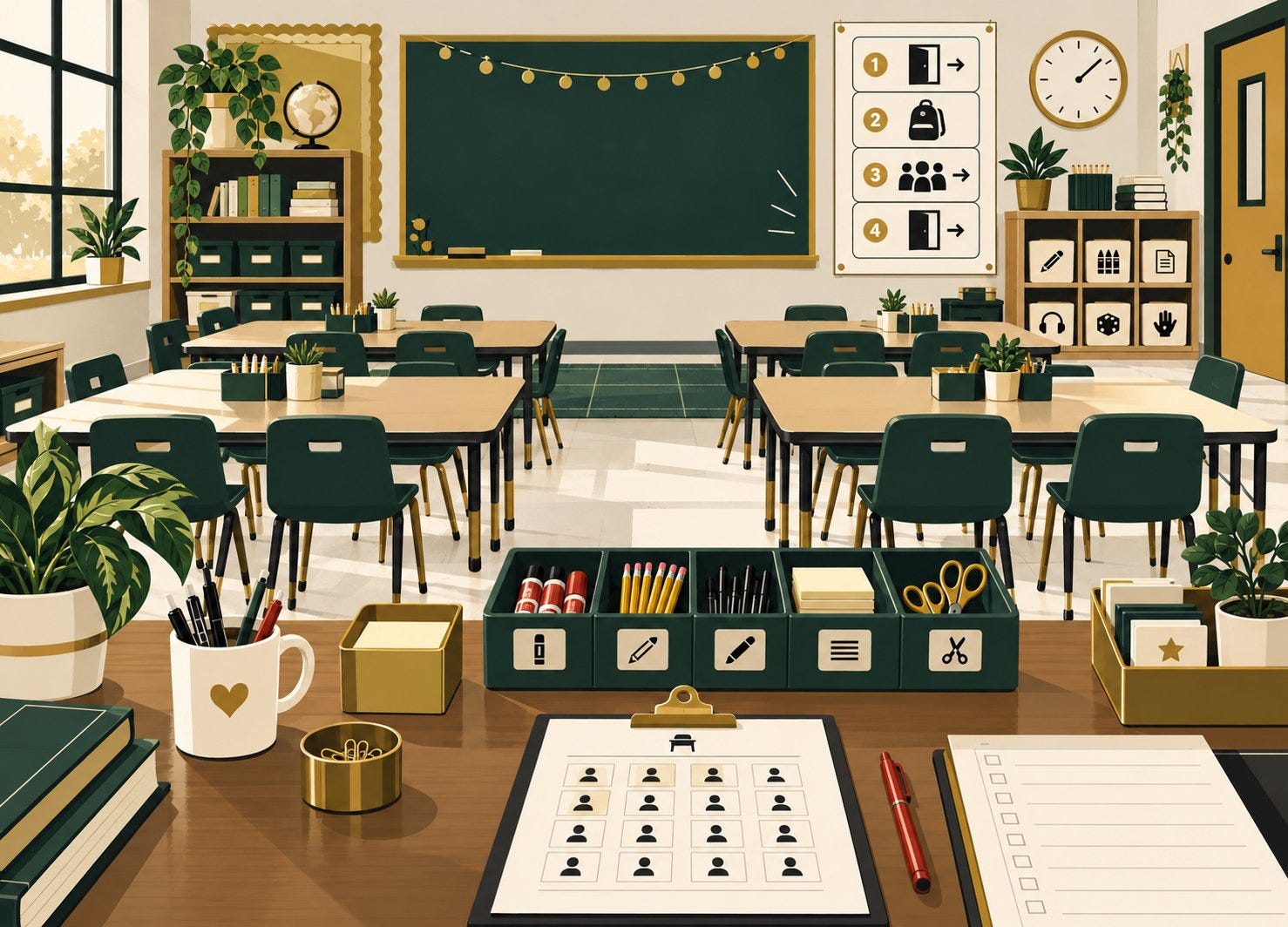
Most new teachers start the year with a speech. Here are the rules, here are the consequences, here is what I expect. Students listen politely, and by the third week none of it is happening.
The speech isn't the problem. The problem is that a speech is a one-time event and classroom management is something you do every single day. What carries a classroom is a set of systems: routines students can run without you, expectations that are the same on Monday and Friday, and follow-through they can predict.
This post is a starting kit. Every link goes to a free guide or template on Elevate the Norm, and none of them ask for an email address.
Start with a plan you can explain in one minute
If you can't explain your classroom management plan in one minute, students can't follow it. A good plan answers four questions:
What do students do when they walk in?
How do they get your attention, and how do you get theirs?
What happens when someone does the right thing?
What happens when someone doesn't?
If you're building one from scratch, start here: What Is a Classroom Management Plan?
Then pick a style that fits you. Some teachers run a tight, structured room. Others run a looser, discussion-heavy room. Both can work, as long as it's consistent. Compare the options in Classroom Management Styles.
Routines do the heavy lifting
Every minute that isn't covered by a routine is a minute students fill on their own. The routines that matter most:
Entry: What's on the board when they walk in. (A daily bell ringer handles this.)
Materials: Where things are, who passes them out, how they come back.
Transitions: Moving from notes to group work to individual work without losing five minutes each time. See Classroom Transitions Examples.
Exit: Nobody leaves until the exit ticket is turned in.
Not sure what you're missing? Run through the Classroom Routines and Procedures Checklist.
Your seating chart is a management tool
Where students sit decides who they talk to, who they distract, and who you can reach quickly. Make your seating chart on purpose, change it when it's not working, and don't apologize for it. Free template: Classroom Seating Chart Template.
Catch them doing it right
Positive reinforcement isn't about being soft. It is about making the right behavior the most noticed behavior in the room. When students see that showing up, working, and being consistent gets recognized, they start doing more of it.
The key is that recognition has to be consistent. A reward system that runs for two weeks and then quietly disappears teaches students that your systems don't last.
Positive reinforcement also works better with older students than many teachers expect. See Positive Discipline for Teens, and for the bigger picture, Classroom Management Strategies.
Follow through, every time
A consequence you threaten and don't carry out is worse than no consequence at all. Students aren't testing your rules. They're testing whether you mean them.
Keep your consequences small, predictable, and certain. When you say something will happen, it happens. That's how kindness stops looking like weakness.
Keep a paper trail
Document parent contact from day one, the good calls along with the hard ones. When a problem does come up, you'll have a record and a relationship to build on. Free template: Parent-Teacher Communication Logs.
Plan for the days you're not there
Your management plan has to survive a substitute. Leave the routines written down, the seating chart printed, and the expectations posted. More here: Substitute Teacher Classroom Management.
Protect yourself, too
First-year teaching is hard, and burnout is real. The systems above aren't only for students. They protect your time and energy so you have something left in October. Read First-Year Teacher Burnout before you need it.
The full guide
All of this, in more depth, is in Classroom Management for New Teachers on Elevate the Norm. For the templates in one place, browse the free resource library.